Weighted Card Draw
Posted: November 29th, 2025, 5:15 am
I have an idea!
The Idea:
For the card draw house rule, I tried to strike a balance between making the game too predictable and too random. I can see now from the data that the limits I chose are barely below what you get with random draw anyway, so they rarely kick in.
However, there are reasons to not simply lower the limits. One reason is that lower limits can complicate the implementation of Victoria Falls.
I think I have a solution that keeps the current hard limits while balancing out the card draw in a way that strikes a better balance between predictability and randomness.
The idea is to use weighted probabilities. In addition to being limits, the numbers in the table become the weighted probability that a given type of card will be drawn:
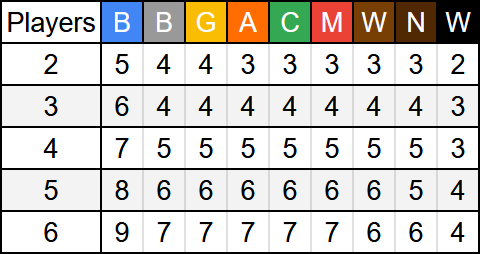
The trick is that once a particular type of card has been selected, the number for that type of card gets reduced by one for the weighting of drawing the next card.
This could be implemented in person by writing the types of cards on slips of paper and putting them into a hat. For 4 players, you'd put 7 slips of paper in the hat that say "Building", 3 that say "War", and 5 for each other type of card. Then you split the deck by card type and shuffle each of those decks. When you draw a slip of paper from the hat, draw that type of card. Don't return any slips of paper to the hat until the next round. And even then, count the number of cards that stay on the board of each type, and don't return the slips for those cards. If you ever draw a slip of paper and there are no remaining cards of that type, keep that slip of paper aside and draw again.
In other words, as you draw cards of a certain type, the probability that you draw more of that type goes down, hence the probability that you draw something else goes up.
The Data:
I ran some experiments. I tried random draw (Random), the current card-draw-limit house rule (Limits), and the proposed weighted-probability card draw (Weighted). For each method, and for each player count, I filled the progress board 1000 times as if it were round 1A.
One metric I collected is how often there wasn't every type of card:
and how often there wasn't every type of non-war card:
I think the above shows that the current house rule doesn't have much impact, while showing that the proposal has an impact without being too severe.
Another set of metrics I collected was histograms of how many of a particular type of card made it to the progress board. Here are the distributions for buildings, colonies, and wars, for 4 players:
As one might expect, the distributions are all roughly Gaussian. Again, the random draw and hard limits are not all that different. The one exception being wars because there are a bunch of wars in the deck.
The Analysis:
The weighted card draw appears to generally reduce the standard deviation, which means increased consistency. It does this without needing reduce the hard limit. You can still get 7 buildings, just with much lower probability. It happened 1/1000 in my experiment.
With the weighted card draw, the average number of buildings drawn went down slightly, from ~3.5 to ~2.8, while the number of other non-war cards went up from ~1.4 to ~2.0. Perhaps of interest, 2.0 * 7/5 = 2.8, so the average for buildings is proportional to its limit of 7 and other cards to their limit of 5. Wars have an average of ~1.2, which is 3/5 of 2.0, so same story. Also, wars go back to being Gaussian instead of a somewhat uniform distribution between 1, 2, and 3.
I think the weighted card draw strikes a much better balance between consistency and randomness than the current hard limits. I don't like having lower hard limits, in part because it completely removes the possibility of having more of that type of card. Also, when there are many of each type of card in the deck, the probability of the next card being any given type barely changes, whereas the weighted card draw centers the averages proportional to the initial weights while still allowing for reasonable variance in each category.
The Question:
What should I do?
I like the proposed weighted-probability card-draw method. I also think the current house rule isn't doing much. For these reasons, I think it's best to basically replace the current house rule with the new one.
My current thinking is I have a cut-over where the "Card Draw" house rule starts meaning the weighted probability method instead of the simple hard limits. Any match started before that will continue to use the simple limits. This is necessary because the matches need to play out the same way given the same inputs.
Another option would be to retain the ability to select the current card-draw house rule, either indefinitely or during a phase-out period. I am not in favor of this since the current house rule is close to not having a house rule.
The Request:
Please provide your opinion now. This is your chance to influence the site and potentially your enjoyment of it.
The Idea:
For the card draw house rule, I tried to strike a balance between making the game too predictable and too random. I can see now from the data that the limits I chose are barely below what you get with random draw anyway, so they rarely kick in.
However, there are reasons to not simply lower the limits. One reason is that lower limits can complicate the implementation of Victoria Falls.
I think I have a solution that keeps the current hard limits while balancing out the card draw in a way that strikes a better balance between predictability and randomness.
The idea is to use weighted probabilities. In addition to being limits, the numbers in the table become the weighted probability that a given type of card will be drawn:
The trick is that once a particular type of card has been selected, the number for that type of card gets reduced by one for the weighting of drawing the next card.
This could be implemented in person by writing the types of cards on slips of paper and putting them into a hat. For 4 players, you'd put 7 slips of paper in the hat that say "Building", 3 that say "War", and 5 for each other type of card. Then you split the deck by card type and shuffle each of those decks. When you draw a slip of paper from the hat, draw that type of card. Don't return any slips of paper to the hat until the next round. And even then, count the number of cards that stay on the board of each type, and don't return the slips for those cards. If you ever draw a slip of paper and there are no remaining cards of that type, keep that slip of paper aside and draw again.
In other words, as you draw cards of a certain type, the probability that you draw more of that type goes down, hence the probability that you draw something else goes up.
The Data:
I ran some experiments. I tried random draw (Random), the current card-draw-limit house rule (Limits), and the proposed weighted-probability card draw (Weighted). For each method, and for each player count, I filled the progress board 1000 times as if it were round 1A.
One metric I collected is how often there wasn't every type of card:
- weighted_1.png (4.51 KiB) Viewed 4638921 times
and how often there wasn't every type of non-war card:
- weighted_2.png (4.98 KiB) Viewed 4638921 times
I think the above shows that the current house rule doesn't have much impact, while showing that the proposal has an impact without being too severe.
Another set of metrics I collected was histograms of how many of a particular type of card made it to the progress board. Here are the distributions for buildings, colonies, and wars, for 4 players:
- weighted_3.png (6.83 KiB) Viewed 4638921 times
- weighted_4.png (6.18 KiB) Viewed 4638921 times
- weighted_5.png (6.01 KiB) Viewed 4638921 times
As one might expect, the distributions are all roughly Gaussian. Again, the random draw and hard limits are not all that different. The one exception being wars because there are a bunch of wars in the deck.
The Analysis:
The weighted card draw appears to generally reduce the standard deviation, which means increased consistency. It does this without needing reduce the hard limit. You can still get 7 buildings, just with much lower probability. It happened 1/1000 in my experiment.
With the weighted card draw, the average number of buildings drawn went down slightly, from ~3.5 to ~2.8, while the number of other non-war cards went up from ~1.4 to ~2.0. Perhaps of interest, 2.0 * 7/5 = 2.8, so the average for buildings is proportional to its limit of 7 and other cards to their limit of 5. Wars have an average of ~1.2, which is 3/5 of 2.0, so same story. Also, wars go back to being Gaussian instead of a somewhat uniform distribution between 1, 2, and 3.
I think the weighted card draw strikes a much better balance between consistency and randomness than the current hard limits. I don't like having lower hard limits, in part because it completely removes the possibility of having more of that type of card. Also, when there are many of each type of card in the deck, the probability of the next card being any given type barely changes, whereas the weighted card draw centers the averages proportional to the initial weights while still allowing for reasonable variance in each category.
The Question:
What should I do?
I like the proposed weighted-probability card-draw method. I also think the current house rule isn't doing much. For these reasons, I think it's best to basically replace the current house rule with the new one.
My current thinking is I have a cut-over where the "Card Draw" house rule starts meaning the weighted probability method instead of the simple hard limits. Any match started before that will continue to use the simple limits. This is necessary because the matches need to play out the same way given the same inputs.
Another option would be to retain the ability to select the current card-draw house rule, either indefinitely or during a phase-out period. I am not in favor of this since the current house rule is close to not having a house rule.
The Request:
Please provide your opinion now. This is your chance to influence the site and potentially your enjoyment of it.

